Siem Reap Festival Calendar 2026: Dates, Customs and What to Expect
Time your trip to catch water fights, floating lanterns, and celebrations locals wait all year for.
Introduction
Siem Reap's calendar does not follow the working week. It follows the monsoon, the harvest, the lunar months, and a handful of dates the 20th century forced onto it. In 2026 that mix runs from water fights in the street to days of national mourning, sometimes in the same month. This guide lays out the year so you know what you are walking into.
The calendar is anchored by the Three Great Festivals. Chaul Chnam Thmey (Khmer New Year) is the nationwide water fight. Pchum Ben (Ancestors' Day) is the quiet one, spent at the pagoda with family. Bon Om Touk (the Water Festival) marks the day the Tonle Sap reverses its flow. Each changes the city in a different way, and each is covered in detail below.
What follows is the working calendar: the dates, what actually happens on them, and what they mean to the people observing them.
At a Glance: Siem Reap Festival & Holiday Calendar 2026
| Date(s) | Holiday / Festival | Type | Brief Description |
|---|---|---|---|
| January 1 | New Year's Day | National | The international New Year is observed as a public holiday. |
| January 7 | Victory Over Genocide Day | National | A solemn day commemorating the 1979 fall of the Khmer Rouge regime. |
| January 24–25 | Ultra-Trail d'Angkor | Sporting | An international trail-running event with multiple races held within the Angkor Archaeological Park. |
| February 2 (est.) | Meak Bochea Day | Religious | A major Buddhist holiday commemorating Buddha's final sermon. Marked by serene evening candlelight processions at pagodas. |
| March 8 | International Women's Day | National | A public holiday recognizing the role and rights of women. |
| April 14–16 | Chaul Chnam Thmey (Khmer New Year) | Religious / National | The most important festival of the year. Siem Reap hosts the grand Angkor Sankranta event. |
| May 1 | International Labor Day | National | A public holiday celebrating workers' contributions. |
| May 5 | Royal Plowing Ceremony | Cultural / National | An ancient Brahmanic ritual to mark the start of the rice-planting season and predict the harvest. |
| May 14 | King Norodom Sihamoni's Birthday | National | A three-day public holiday celebrating the birth of the reigning monarch. |
| May 22 | Visak Bochea Day | Religious / National | The holiest Buddhist holiday, birth, enlightenment, and nirvana of the Buddha. |
| June 18 | Queen Mother's Birthday | National | A public holiday honouring the birthday of Queen Mother Norodom Monineath Sihanouk. |
| September 24 | Constitutional Day | National | Commemorates the signing of Cambodia's constitution in 1993. |
| October 10–12 | Pchum Ben (Ancestors' Day) | Religious / National | A 15-day festival (with a 3-day public holiday) for honouring deceased ancestors. |
| October 15 | Commemoration of King Father | National | A public holiday honouring the late King Father Norodom Sihanouk. |
| October 29 | King's Coronation Day | National | A public holiday marking the anniversary of King Norodom Sihamoni's coronation. |
| November 9 | Independence Day | National | Celebrates Cambodia's independence from French rule in 1953. |
| November 23–25 | Bon Om Touk (Water Festival) | Cultural / National | A three-day festival celebrating the reversal of the Tonle Sap River's flow, featuring boat races and evening festivities. |
| December 29 | Peace Day | National | A public holiday marking the end of the Cambodian civil war. |
The Heart of the Celebration: Siem Reap's Three Great Festivals
While the calendar is punctuated by numerous holidays, three festivals form the cultural bedrock of the Cambodian year. They are periods of immense social and spiritual significance, triggering mass movements of people across the country and transforming the atmosphere of Siem Reap.
Chaul Chnam Thmey: A New Year's Dawn Over Angkor (April 14–16, 2026)
Chaul Chnam Thmey, the Khmer New Year, is unequivocally the most important and exuberant holiday in Cambodia. Falling in mid-April, it marks the end of the demanding harvest season, a moment when farmers can finally rest and enjoy the fruits of their labor before the onset of the monsoon rains. The three-day festival is a dynamic blend of solemn ritual and unrestrained joy.
The celebration unfolds over three distinct days:
- Day 1. Maha Songkran. Welcoming the new heavenly deity who will protect the world for the coming year. Homes are meticulously cleaned, and families gather at temples with offerings for the monks to receive blessings.
- Day 2. Virak Vanabat. Dedicated to charity and remembrance, with people making donations to the less fortunate and honouring ancestors at monasteries.
- Day 3. Leang Saka. The beautiful ceremony of washing Buddha statues with scented water, a ritual of purification. This act is mirrored within families, as children respectfully wash their parents and grandparents to ask for forgiveness and receive blessings for the year ahead.
Siem Reap's Epicenter: Angkor Sankranta. While Khmer New Year is celebrated nationwide, Siem Reap has become the undisputed national epicenter of the festivities. Angkor Sankranta, a massive cultural event organised by the Union of Youth Federations of Cambodia, transforms the entire Angkor Archaeological Park into a grand stage, traditional games, large-scale folk dance, art exhibitions, concerts.
An insider's note on the celebrations. For the visitor, the experience is immersive and chaotic in the most delightful way. The city's streets, particularly around Pub Street and the riverside, erupt into a massive, three-day water fight. Locals and tourists arm themselves with water guns and buckets, dousing everyone in sight as a playful act of blessing and purification. This is often accompanied by talcum powder, which ancient Cambodians believed could ward off evil spirits.
⚠ Planning note. This period is a time of immense domestic travel. Siem Reap becomes extremely crowded. Book accommodation and transport well in advance.
Pchum Ben: A Sacred Communion with Ancestors (October 10–12, 2026)
If Khmer New Year is an explosion of outward joy, Pchum Ben is a period of profound inward reflection and spiritual duty. Known as Ancestors' Day or the Festival of the Dead, this 15-day observance, culminating in a three-day public holiday, is rooted in the belief that the gates of hell are opened, allowing the spirits of the dead to roam the earth for 15 days to receive offerings from their living relatives.
Spiritual core. Families have a sacred duty to care for their ancestors, up to seven generations back. Many spirits, due to past sins, are believed to be reborn as Preta, or hungry ghosts, with tiny pinhole mouths that prevent them from eating normally. During Pchum Ben, they are released to seek food and merit from their descendants. If a spirit visits seven pagodas and finds no offerings from its family, it is said to return and curse the living relatives. This belief drives the deep devotion seen throughout the festival.
Rituals in Siem Reap. In the pre-dawn hours, pagodas like Wat Bo and Wat Damnak become hives of quiet, purposeful activity. Families, often dressed in white, arrive with elaborate food offerings for the monks. One of the most unique rituals is the making and offering of bay ben, balls of sticky rice, often mixed with sesame or coconut. Before sunrise, these rice balls are tossed onto the temple grounds or into the air as direct offerings to the hungry ghosts.
🙏 Respectful participation. Dress modestly when visiting pagodas, covering shoulders and knees, and maintain a quiet, respectful demeanour, refraining from intrusive photography.
Bon Om Touk: The Reversing River's Spectacle (November 23–25, 2026)
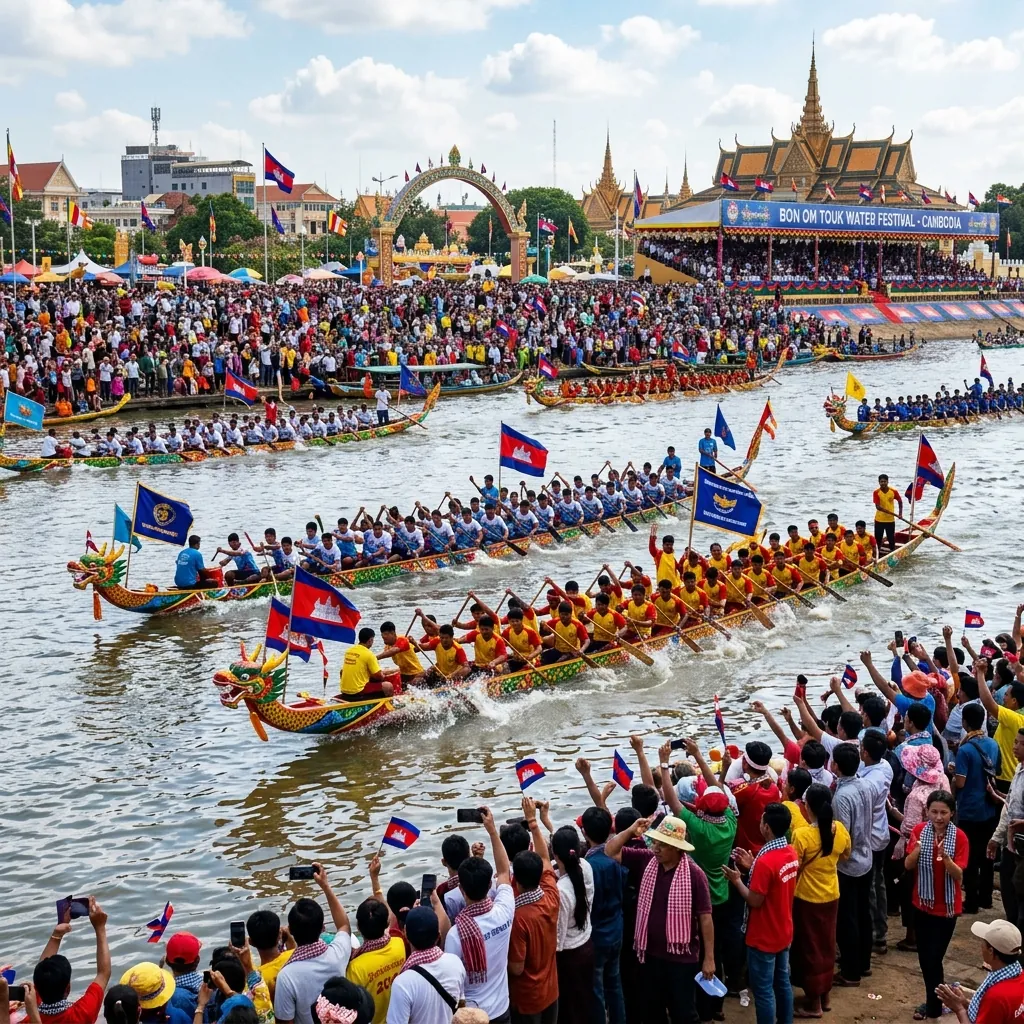
Bon Om Touk, the Water Festival, is a spectacular celebration of one of Cambodia's most remarkable natural phenomena: the reversal of the Tonle Sap River's flow. At the height of the monsoon season, the Mekong River swells with such force that it pushes water back up its tributary, the Tonle Sap, causing the Great Lake to expand dramatically. As the monsoon wanes, the current reverses, and the water flows back out toward the Mekong. This event, which typically occurs in November, marks the end of the rains and the beginning of the bountiful fishing season.
Siem Reap vs Phnom Penh. The largest celebration takes place in the capital, where hundreds of long, brightly painted dragon boats compete on the Tonle Sap. Siem Reap offers a more relaxed and accessible version of the festival, boat races on the Siem Reap River, smaller in scale but imbued with immense local pride. An excellent choice for travelers who wish to experience the spirit of the festival without the overwhelming crowds of the capital.
A feast for the senses:
- By day, riverbanks filled with spectators cheering on their village's boat teams.
- As night falls, an illuminated boat procession (bandaet pratip) glides down the river, with each glowing float representing a different ministry or corporation.
- Midnight ritual, at midnight on the full moon, Cambodians eat auk ambok, a special dish of flattened, roasted rice mixed with coconut and banana, to bring good luck for the coming harvest.
- Grand finale, spectacular fireworks displays light up the night sky.
Seasonal and Spiritual Observances
Beyond the three great festivals, Siem Reap's calendar is woven with numerous other holidays that reflect the nation's spiritual life and historical journey.
Victory Over Genocide Day (January 7)
One of Cambodia's most significant and emotionally complex modern holidays. It commemorates the day in 1979 when Vietnamese forces and Cambodian defectors entered Phnom Penh, overthrowing the genocidal Khmer Rouge regime responsible for the deaths of an estimated 1.7 million people. For every Cambodian family, the day is a profound moment of remembrance.
Meak Bochea Day (Estimated February 2, 2026)
This important Buddhist holiday falls on the full moon of the third lunar month. It commemorates a spontaneous gathering of 1,250 of the Buddha's enlightened disciples, to whom he delivered his final core teachings. The most beautiful and accessible ritual for visitors is the evening candlelight procession, where monks and laypeople, dressed in white, circle the main temple three times, holding candles, incense, and lotus flowers.
Royal Plowing Ceremony (May 5)
This ancient Brahmanic ceremony marks the official beginning of the rice-planting season. Two sacred oxen are hitched to a ceremonial plow and led to seven golden trays containing rice, corn, beans, sesame, grass, water, and rice wine. Royal astrologers then interpret what the oxen choose to eat to predict the outcome of the coming harvest.
Visak Bochea Day (May 22)
The holiest day in the Buddhist calendar. A triple commemoration, the Buddha's birth, enlightenment, and passing into nirvana. As with Meak Bochea, the day culminates in beautiful and solemn evening candlelight processions around the temples.
Independence Day (November 9)
Commemorates Cambodia's independence from nearly a century of French colonial rule in 1953. Although the largest parades and formal events are in the capital, a festive and proud atmosphere pervades the entire country. In Siem Reap, visitors will see Cambodian flags displayed prominently.
Beyond Tradition: Modern and Sporting Events
The Ultra-Trail d'Angkor (January 24–25, 2026)
One of the most remarkable events on the modern calendar, an internationally recognized trail-running race through the heart of the Angkor Archaeological Park. Multiple distances: 8 km, 25 km, 50 km, 100 km ultramarathon, plus walking and Nordic-walking options. Runners pass through remote jungle trails, rice paddies, and small villages, with the thousand-year-old temples of the Khmer empire serving as a constant backdrop.
Practical Guidance for Travelers
For the peak festival periods, Khmer New Year (April), Pchum Ben (October), and Bon Om Touk (November), it is essential to book accommodation and transportation far in advance. Domestic travel volumes mean hotels, guesthouses, buses, and taxis become fully booked weeks ahead.
Cultural etiquette:
- Modest dress, at any pagoda, cover shoulders and knees; carry a scarf or sarong.
- Remove shoes, before entering a temple's main sanctuary.
- Photography, maintain a respectful distance; ask permission before close-up photos of individuals in prayer.
- Water festival fun, being doused with water is rooted in good-natured blessing. A smile is the best response.
Practicalities: April heat during Khmer New Year can exceed 35 °C; stay hydrated. In crowded festival environments, be mindful of personal belongings and leave valuables in your hotel safe.