Getting Around Siem Reap: Tuk-Tuks, PassApp, Grab, Buses and the Airport
Every mode of transport you will actually use, with realistic prices and the apps that handle each one.
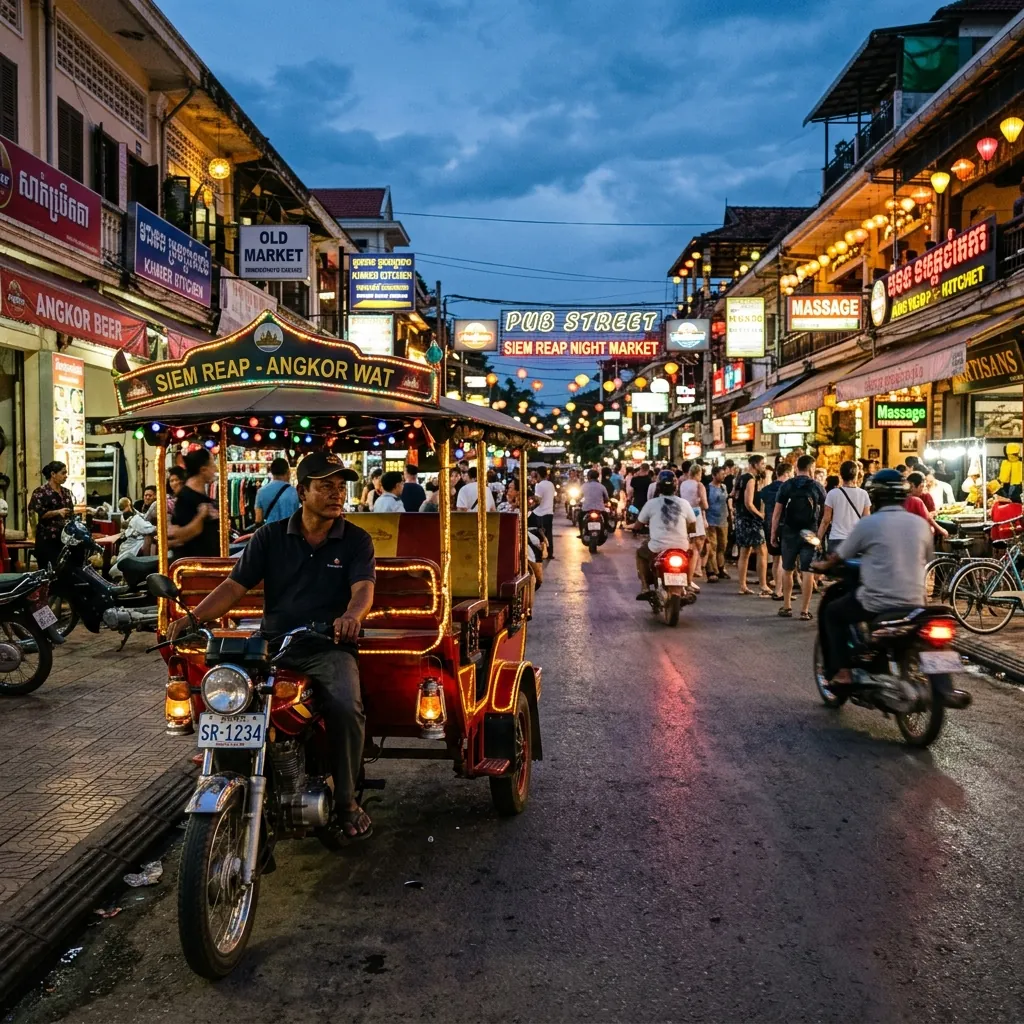
Getting around Siem Reap is one of the easier travel experiences in Southeast Asia. The city is small, the tuk-tuk supply is endless, and two competing ride-hailing apps mean you almost never need to haggle. This guide covers every mode of transport you will likely use during a visit, with realistic prices and the apps that handle each one.
The two apps to install
PassApp
The Cambodian ride-hailing app. Works in Phnom Penh, Siem Reap, Sihanoukville, Battambang, Kampong Cham, and Kampot. Fixed fares, so no haggling.
- Tuk-tuks (remorks): 3,000 riel (about $0.75) for the first kilometer, then per-distance.
- Rickshaw cabs (the small three-wheeled auto-rickshaws): similar to tuk-tuks, slightly faster.
- Standard sedan taxis: 5,000 riel (about $1.25) for the first kilometer.
- SUVs: available for groups or to the airport.
PassApp generally comes out cheaper than Grab on the same route. Most long-term residents have PassApp open by default.
Grab
The international Southeast Asian super-app. Works across Cambodia, Thailand, Vietnam, Singapore, and beyond. Same general experience as PassApp but typically 20 to 50 percent more expensive locally. The advantage is that the same app works when you cross borders, and the in-app English support is more polished.
A practical pattern used by experienced travelers: open both apps, request a ride in each at the same destination, accept whichever finds a driver first or has the better price.
Both apps require a phone number to register. A Cambodian SIM card is the most reliable path; international numbers sometimes have SMS verification problems.
Tuk-tuks and remorks: the difference
Two things in Siem Reap both get called "tuk-tuks" in casual English. They are different vehicles.
- Remork-moto: a small two-wheel passenger cart pulled by a motorbike. This is the traditional Cambodian tuk-tuk you see most often. Four passengers comfortably, six at a squeeze. Open-sided, breezy, slower in traffic. The tuk-tuk most people picture.
- Auto-rickshaw (commonly called "rickshaw"): a small three-wheeled vehicle, like an Indian or Thai tuk-tuk. Fully enclosed cabin with windows. Two or three passengers. Faster, more weatherproof, more popular for short city trips.
Both modes appear in the PassApp and Grab apps. Choose based on weather, luggage, and group size.
What things cost
Approximate fares in U.S. dollars within central Siem Reap, day or night:
| Trip | Tuk-tuk (PassApp) | Tuk-tuk (Grab) | Private hire car |
|---|---|---|---|
| Hotel to Pub Street | $1 to $2 | $1.50 to $3 | $3 to $5 |
| Pub Street to anywhere in the city | $1 to $3 | $1.50 to $4 | $3 to $6 |
| City to Angkor Wat (one way) | $4 to $6 | $5 to $8 | $10 to $15 |
| Full-day temple tour (chartered tuk-tuk) | $20 to $25 | $25 to $35 | $50 to $80 |
| Siem Reap–Angkor International Airport (SAI) | $7 to $12 | $10 to $15 | $15 to $25 |
| Cross-country to Phnom Penh (6 hours by car) | not available | not available | $80 to $130 per car |
Haggling for unmetered street tuk-tuks is still common. A street tuk-tuk will start at $5 or $7 for a trip the apps would price at $2 to $3. Counter at $3 and settle around $3 to $4 if you do not want to use the app. Or just open PassApp.
Getting to the airport
The new Siem Reap-Angkor International Airport (SAI) opened in October 2023, replacing the old in-town airport. It is about 50 km from the city center, in Sotr Nikum district, so the journey is longer than visitors expect.
- By PassApp or Grab car: $12 to $20. About 45 to 60 minutes. The most common choice.
- By tuk-tuk: technically possible but not recommended. The journey takes 90 to 120 minutes on hot open road. Limited shade. Engine noise. Book a car.
- By private hire: $15 to $25 with a sedan, $25 to $40 with a larger vehicle for luggage and groups. Most hotels can arrange this with one phone call.
- Hotel shuttle: many four-star and five-star hotels include airport pickup. Confirm at booking.
- Public bus: a shuttle bus runs between the airport and the city, currently around 30,000 riel (about $7.50). Less reliable schedule than ride-hailing but the cheapest option. Look for the airport shuttle counter inside the terminal.
Allow 90 minutes from your hotel to airport security at peak times. Cambodian domestic flights are punctual; international flights mostly are.
Public buses around town
Siem Reap has limited public bus coverage within the city itself. Most local transit is by tuk-tuk and motorbike taxi.
For routes between Siem Reap and other Cambodian cities, three companies dominate:
- Giant Ibis: the most reputable long-distance bus operator in Cambodia. Modern fleet, free WiFi, snacks, USB charging, English-speaking staff. Booking through their website giantibis.com or via the Bookmebus app. Siem Reap to Phnom Penh runs $15 to $19 one way, 6 hours.
- Mekong Express: older fleet, slightly cheaper, still considered safe. Siem Reap to Phnom Penh about $12 to $15.
- Cambodia Post VIP Van: minivan service rather than full bus, faster but cramped. Siem Reap to Phnom Penh about $13.
For longer journeys (Siem Reap to Bangkok via the Poipet border, for example), Giant Ibis remains the most reliable choice at around $30 to $40 per leg.
Private hire cars
For half-day or full-day excursions outside the city (Phnom Kulen waterfalls, the floating villages, Banteay Srei temple), a private car with driver is usually the best value.
- Half day (4 hours): $25 to $40
- Full day (10 hours): $50 to $80 within a 50 km radius
- Multi-day charter: $60 to $90 per day depending on the route
Most guesthouse desks can arrange this. Confirm the car has air conditioning, ask about included fuel costs, and agree the route in writing before setting off. Tipping the driver $5 to $10 at the end of a full day is appreciated.
Motorbike rental
For visitors planning to explore on their own and confident in two-wheel traffic, a 110cc to 125cc scooter rents for $5 to $8 per day. Expect to leave a passport or a deposit at the rental shop. Helmets are included but check the fit. Fuel runs about $1 per liter at the time of writing.
Important: an International Driving Permit (IDP) is technically required for foreigners to drive in Cambodia. Police rarely check in Siem Reap, but if there is an accident, lack of an IDP can void travel insurance and complicate matters. Most short-term visitors take the risk; many regret it after the one ride that does not go well.
Practical apps to install
| App | What it is | Required? |
|---|---|---|
| PassApp | Tuk-tuks, taxis, SUVs | Yes if you plan multiple rides |
| Grab | Same, backup, also food delivery | Yes |
| Bookmebus | Inter-city bus and minivan bookings | If you are traveling beyond Siem Reap |
| Maps.me | Offline city map, works without data | Strongly recommended |
| Google Translate | Khmer ↔ English | Useful for driver communication |
What to avoid
- Unmetered street tuk-tuks at the airport. They will quote three to five times the app price. Book ride-hailing in the arrivals hall instead.
- Drivers offering "I take you everywhere for $20". The standard half-day rate is $15 to $25, but agree the route first. Open-ended deals turn into surprise upcharges.
- Border-crossing scams at Poipet if you are traveling overland to Thailand. The legitimate route is by bus through the legitimate border. Scam touts will direct you to overpriced "VIP" transit through unofficial booths.
Getting around Siem Reap is one of the easier things you will do in Cambodia. Install PassApp, learn the difference between a remork and a rickshaw, and the city opens up.